
Practice of Measuring ⚖️
Some form of measuring, along with navigation, would have been one of the earliest mathematical activities. Clay tokens and sealed clay bullae containing small counters seem to have been used to enumerate and account for quantities such as sheep flocks in Mesopotamia as early as the 8th–7th millennium BCE. Every specific civilization since then has been noticed to have had systems of (evolving) measures. Often, the standardisation of measures also served as a proxy for the sovereign, with rulers issuing, displaying, and enforcing official standards to assert authority, ensure justice, and legitimise taxation, such as the royal cubit rods of Egypt, the Hammurabi stele proclaiming Mesopotamian standards, or medieval English Exchequer yardsticks.
This also meant that measures and standards have always been sites of contestation and negotiation, often becoming arenas where political power, authority, and legitimacy are worked out. We see this in the public display of standard measures in temple inscriptions such as in Seeyamangalam, and also in the introduction of the metric system in France after the French Revolution, where redefining units was part of redefining the notions of sovereignty and equality.
Overview of Measuring collection
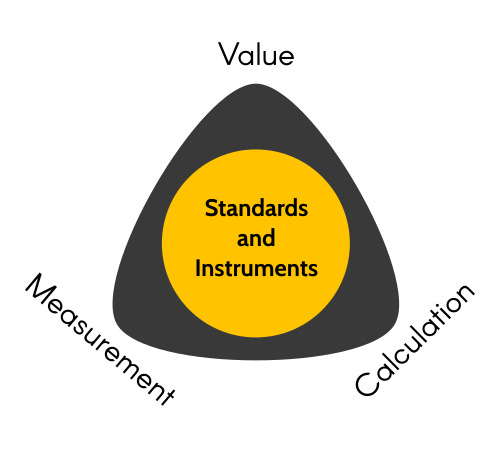
Measuring instruments, as concrete manifestations of measures and standards, are then products of various negotiations, expectations, social needs, and contestations. Further, they play a major role in relating standards, measurement, and calculation, and in arbitrating justice. In this sense they embody complex histories and play a significant role in shaping social lives.
Knowing what kind of instruments were used, their various affordances, social and political contexts thus helps us not only understand the types and kinds of measurement standards and how they were established, but also the possible social relations they presupposed and reproduced. For instance, an instrument like the Kuliayan, which emerged as measure of 'wages in paddy' in the Kuttanad region of Keralam, can be read as embedded in the complex history of changing labour relations as argued here [insert link to Kuliayan article].
Valuation and measuring instruments
The determination or ascription of value to anything (whether it be monetary value or any other form of ranking) often involves the act of physical measuring using a measuring instrument, followed by computational activities that filter and abstract 'messy' realities into standardised numbers. The relative extent of each process varies from instrument to instrument. While producing a length measure through a simple ruler requires just reading the marking, vernier calipers demand some computations. Notional measuring instruments like credit score calculators or minimum wage formula, which rely on complex algorithms and legal arbitration, it can be argued that naturalise inequalities by translating risks into profits while erasing unpaid care work or lived precarity. Investigating how measuring instruments materialise exclusions, computations distribute value flows, and both together legitimise hierarchies as "objective math" can thus deepen our understanding of social relations and stratification.
References and further Readings
[1]. Mathematics and Society: Numbers and Measures in Early Modern South India by Senthil Babu D.
[2]. Trust in Numbers: The Pursuit of Objectivity in Science and Public Life by Theodore Porter.
[3]. Measures and Men by Witold Kula.