
Assets for Reference
Collection-
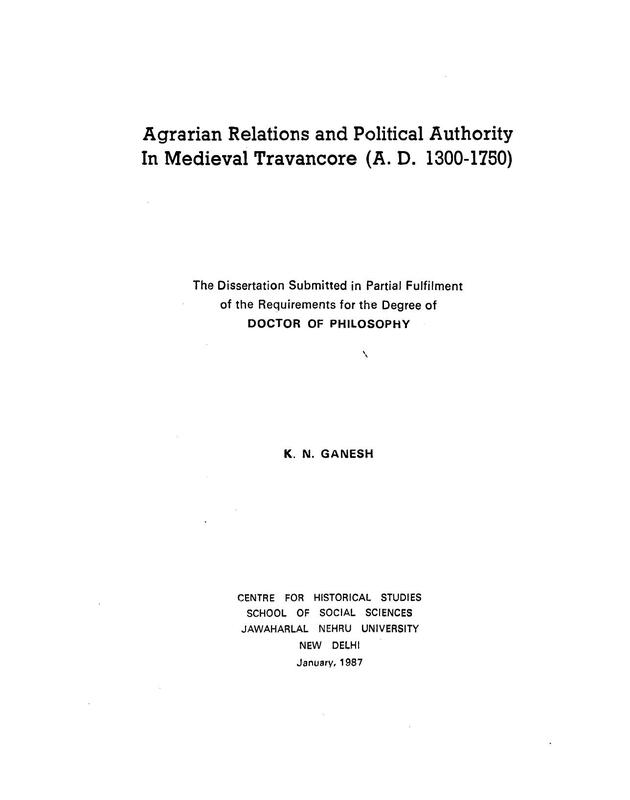
Agrarian Relations and Political Authority, In Medieval Travncore (A.D. 1300-1750)
reference workThe importance of regional studies in providing a comprehensive framework for the writing of Indian History has been recognized for a long time. The Indian subcontinent displays considerable diversity in geography, language, culture and economic conditions. It is not surprising that a general theory which can explain all the regional variations in the social and economic development of India has proved elusive. However, detailed regional studies that have been undertaken recently are useful in throwing light into a number of problems that a student of history faces while analyzing the socio-economic structure of a particular period or the character of a social movement. Such studies have also demonstrated the complexities involved in applying an accepted historical concept or category in a specific regional context.1987 -

Digital Humanities at Yale: Resources and Initiatives
web content“Digital Humanities at Yale: resources and initiatives” presentation by Ayesha Ramachandran (Associate Professor of Comparative Literature) & Christophe Schuwey (Assistant Professor of French) at the Graduate School of Arts and Sciences Interdisciplinary Humanities Symposium. More information can be found here.Sep 10, 2026 -

Digital Humanities, Open Source, and Communities of Learning
web contentIn this episode of The Docs Are In, Dr. Lisa Tagliaferri (Senior Director, Developer Education, Chainguard; Adjunct Professor, Rutgers University) drops in to chat with Kate and Kelly about her experiences working at tech startups and in academia. Lisa discusses her work in Digital Humanities (or DH--where digital technologies and the humanities intersect), her research into medieval communities of learning (do we have any Catherine of Siena fans out there?), and how this all relates to open source communities. Also of interest: Lisa’s experiences with her DH graduate seminar, her work at Chainguard, and how academic training can translate to a career in tech.Sep 10, 2026 -

Pseudo history and digital history - The Dangerous art of text mining
web contentJo argues that a world awash in text requires interpretive tools that traditional quantitative science cannot provide. Text mining is dangerous because analysts trained in quantification often lack a sense of what could go wrong when archives are biased, incomplete, or evidence the suppressions of the past. Jo's talk will review a brief catalogue of disasters created by data science experts who voyage into humanistic study. It finds a solution in “hybrid knowledge,” or the application of historical methods to algorithm and analysis. Case studies engage recent work from the philosophy of history (including Koselleck, Erle, Assman, Tanaka, Chakrabarty, and others) and investigate the “fit” of algorithms with each historical frame of reference on the past.Sep 10, 2026 -
Whose Digital Preservation? Locating Our Standpoints to Reallocate Resources
web contentJul 07, 2024