
Telugu
CollectionAbout this Collection
It is reasonable to assume that Telugu also had an oral mathematical tradition based on mnemonics and rhymes. For example, Sarma (1985) documents that problems similar to Josephus Problem appears to have been part of a local culture of riddles posed in verse, with two different versions and solutions found in nearby areas of Andhra Pradesh. A systematic documentation of these traditions has yet not been done.
Among Telugu mathematical manuscripts, the most important is Sāra Sangraha Gaṇitamu by Pavaluru Mallana, commonly known as Pavalūri Gaṇitamu. This text is regarded as a Telugu adaptation of Mahāvīrācārya’s Sanskrit work Gaṇitasārasaṅgraha. However, Mallana himself, and later copyists, added their own contributions such as new problems at suitable places, and incorporation of local weights and measures where needed. S. R. Sarma notes that one chapter of Pavalūri Gaṇitamu, dealing with geometrical calculations such as area, changed considerably over time as village accountants (karaṇams) adapted it to their practical needs and to evolving local units of area and length.
Besides Pavalūri Gaṇitamu, very few mathematical manuscripts in Telugu are known. A commentary on Līlāvatī is another notable one. Sarma suggests that the popularity of Pavalūri Gaṇitamu may have discouraged the composition of new texts, since interested people preferred to copy and add their own notes to this work rather than write entirely new treatises.
For more details, especially on interesting mathematical content in Pavalūri Gaṇitamu, see Sarma (1985).
At present, we are not aware of Telugu texts or manuscripts that are not strictly mathematical but still reflect mathematical practices in other applied fields such as śilpaśāstiram, navāiśāstiram(shipbuilding), or mānayādiśāstiram. We would be glad to learn of such texts if they exist.
Currently our collection is limited to few copies of Sāra Sangraha Gaṇitamu or texts related to it. In addition to we also have an unidentitied copper plate and palm leaf manuscript which needs to be read by an expert.
We welcome interested individuals to help expand our collection and to work systematically on documenting the available Telugu material.
Reference
Sreeramula Rajeswara Sarma , ‘Mathematical Literature in Telugu: An Overview,’ Sri Venkateswara University Oriental Journal, 28 (1985) 77-90.
Among Telugu mathematical manuscripts, the most important is Sāra Sangraha Gaṇitamu by Pavaluru Mallana, commonly known as Pavalūri Gaṇitamu. This text is regarded as a Telugu adaptation of Mahāvīrācārya’s Sanskrit work Gaṇitasārasaṅgraha. However, Mallana himself, and later copyists, added their own contributions such as new problems at suitable places, and incorporation of local weights and measures where needed. S. R. Sarma notes that one chapter of Pavalūri Gaṇitamu, dealing with geometrical calculations such as area, changed considerably over time as village accountants (karaṇams) adapted it to their practical needs and to evolving local units of area and length.
Besides Pavalūri Gaṇitamu, very few mathematical manuscripts in Telugu are known. A commentary on Līlāvatī is another notable one. Sarma suggests that the popularity of Pavalūri Gaṇitamu may have discouraged the composition of new texts, since interested people preferred to copy and add their own notes to this work rather than write entirely new treatises.
For more details, especially on interesting mathematical content in Pavalūri Gaṇitamu, see Sarma (1985).
At present, we are not aware of Telugu texts or manuscripts that are not strictly mathematical but still reflect mathematical practices in other applied fields such as śilpaśāstiram, navāiśāstiram(shipbuilding), or mānayādiśāstiram. We would be glad to learn of such texts if they exist.
Currently our collection is limited to few copies of Sāra Sangraha Gaṇitamu or texts related to it. In addition to we also have an unidentitied copper plate and palm leaf manuscript which needs to be read by an expert.
We welcome interested individuals to help expand our collection and to work systematically on documenting the available Telugu material.
Reference
Sreeramula Rajeswara Sarma , ‘Mathematical Literature in Telugu: An Overview,’ Sri Venkateswara University Oriental Journal, 28 (1985) 77-90.
-

Chaya Ganithamu
Physical ObjectChayaganithamu translates to “mathematics of shadows.” In this sense, it possibly refers to trigonometry, since early trigonometric calculations were derived from the geometry of shadows. The context of the text needs to be determined. Most likely it was pedagogical. It is likely a book/chapter of Sara Sangraha GanitamuJul 02, 2024 -
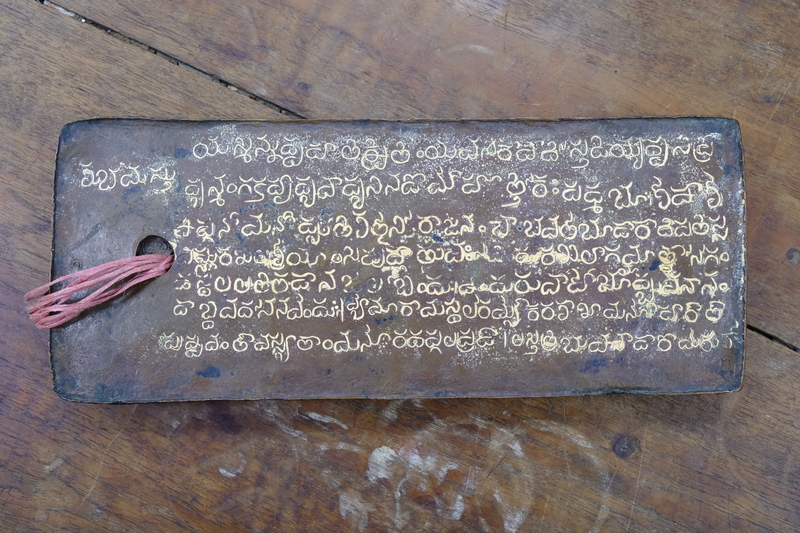
Copper Plates
InscriptionJul 02, 2024 -

Ganithamu
Physical ObjectThe name suggests that the manuscript deals with mathematical practices. It may be related to Sara Sangraha Ganitamu. May also be an incomplete copy of Sara Sangraha Ganitamu, particularly the chapter book/called Trirashikamu which deals with rule of three. These needs to be ascertained through closer examination.Jul 02, 2024 -

Ganithasara Sangrahamu
Physical ObjectLikely a copy of Sara Sangraha Ganitamu by Pavuluru Mallana. We have three other manuscripts of the same title in our collection. The text is considered to be a adaptation of Gaṇitasārasan̄graha by Mahaviracharya into Telegu by Pavaluru Mallana. The text also describes the system of weights, measures, and coinage used in Andhra in that era. The manuscript needs to be closely examined.Jul 02, 2024 -

Ganithasara Sangrahamu
Physical ObjectLikely a copy of Sara Sangraha Ganitamu by Pavuluru Mallana. We have three other manuscripts of the same title in our collection. The text is considered to be a adaptation of Gaṇitasārasan̄graha by Mahaviracharya into Telegu by Pavaluru Mallana. The text also describes the system of weights, measures, and coinage used in Andhra in that era. The manuscript needs to be closely examined.Jul 02, 2024 -

Ganithasara Sangrahamu
Physical ObjectLikely a copy of Sara Sangraha Ganitamu by Pavuluru Mallana. We have three other manuscripts of the same title in our collection. The text is considered to be a adaptation of Gaṇitasārasan̄graha by Mahaviracharya into Telegu by Pavaluru Mallana. The text also describes the system of weights, measures, and coinage used in Andhra in that era. The manuscript needs to be closely examined.Jul 02, 2024 -

Ganithasara Sangrahamu
Physical ObjectLikely a copy of Sara Sangraha Ganitamu by Pavuluru Mallana. We have three other manuscripts of the same title in our collection. The text is considered to be a adaptation of Gaṇitasārasan̄graha by Mahaviracharya into Telegu by Pavaluru Mallana. The text also describes the system of weights, measures, and coinage used in Andhra in that era.Jul 02, 2024 -

Ganithasastramu
Physical ObjectThe title of this manuscript translates as Mathematical Sciences. The content and nature of this manuscript is yet to be ascertained. It is also not clear if it is related to Sara Sangraha Ganitamu.Jul 02, 2024 -

Kshetraganithamu
Physical ObjectLikely a manuscript on geometrical computations and techniques. May be a part of Sāra Sangraha Ganitamu. The manuscript needs to be closely studied to ascertain these.Jul 02, 2024 -

Kshetraganithamu
Physical ObjectLikely a manuscript on geometrical computations and techniques. Could be a part of Sāra Sangraha Ganitamu. The manuscript needs to be closely studied to ascertain these.Jul 02, 2024 -
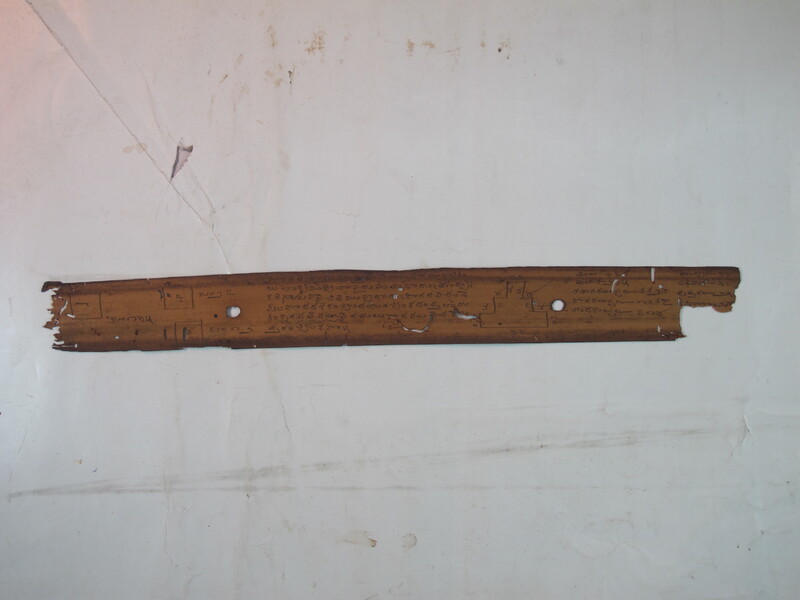
Kshetraganithamu
Physical ObjectIncomplete and partially damaged. Likely a manuscript on geometrical computations and techniques. Most likely a part of Sāra Sangraha Ganitamu. The manuscript needs to be closely studied to ascertain these.Jul 02, 2024 -
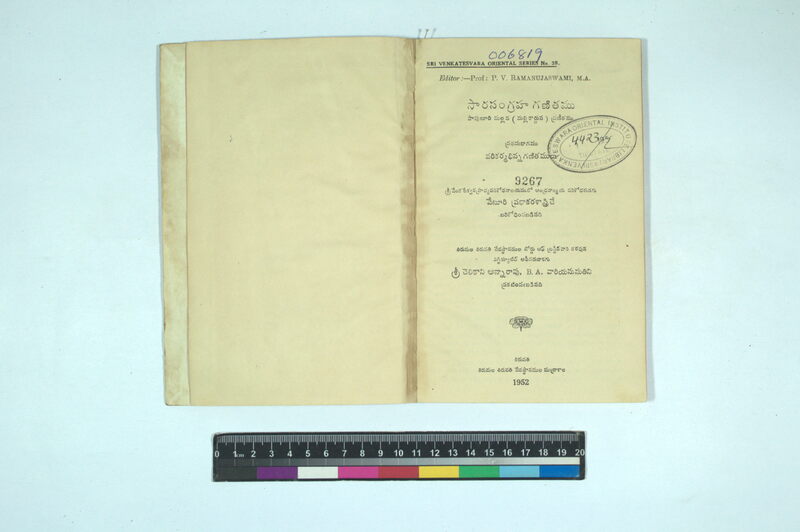
Sara Sangraha Ganitamu
Physical ObjectAn edited volume of Sara Sangraha Ganitamu by Pavaluru Mallana. Edited by Veturi Prabhakara Sastri as part of Sri Venkatesvara Library's oriental series. The edited volume is incomplete as the editor passed away before completion. The text is considered to be a adaptation of Gaṇitasārasan̄graha by Mahaviracharya into Telegu by Pavaluru Mallana by some scholars. However, P. V Ramanujaswami in the preface to the edited volume notes that some of the problems and chapters in Mallana's work has no parallels in Gaṇitasārasan̄graha. The extent of Mallana's original contributions is yet to be studied in detail. The chapters/books of the text are named as follows, Parikarmaganitamu, Bhinnaganitamu, Prakr̥inatiganitamu, Trairāśikagāṇitamu, Miśrāgaṇitamu, Sūtraganitamu, Kṣetraganitamu, Suvarṇaganitamu, Khātaganitamu, Chāyāgaṇitamu. A complete reconstruction of Mallana's work either as an edited volume or otherwise is not available as of yet to our knowledge.May 10, 2024 -
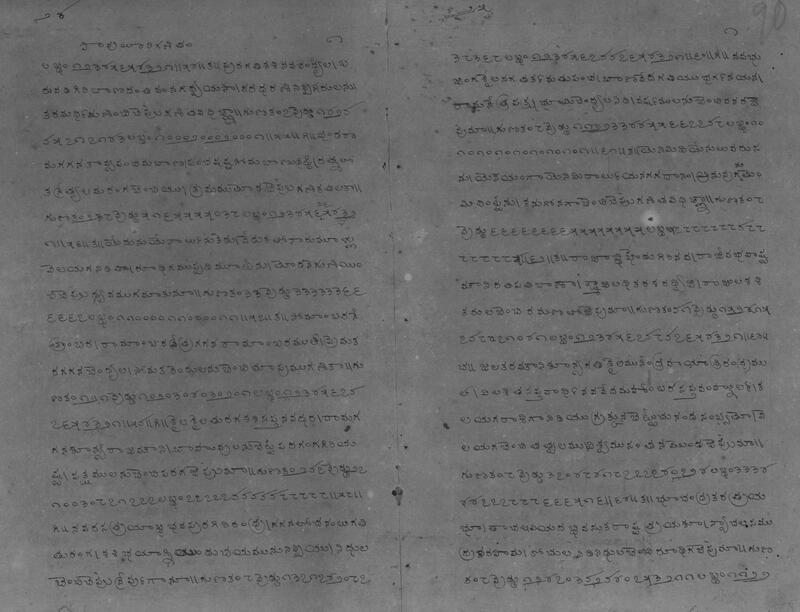
Sara Sangraha Ganitamu
Physical ObjectA hand written copy of Sara Sangraha Ganitamu. However we do not know who copied the text and when.Jul 02, 2024 -
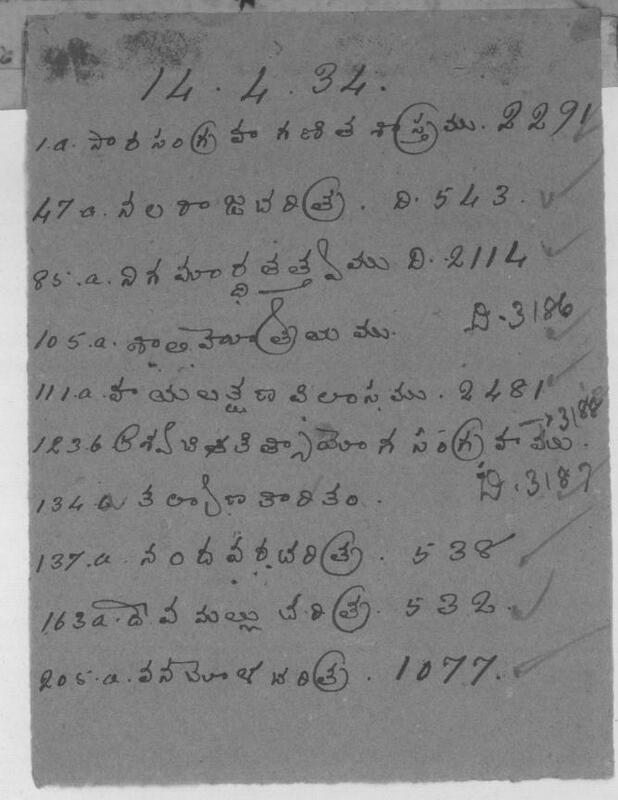
Sara Sangraha Ganitamu
Physical ObjectA hand written copy of Sara Sangraha Ganitamu. However we do not know who copied the text and when.Jul 02, 2024 -

Sara Sangraha Ganitasastramu
Physical ObjectLikely a copy of Sara sangraha Ganitamu. Sara sangraha Ganitamu is a Telugu mathematical treatise, commonly identified as Pavuluri Ganitamu, and regarded as an adaptation of Mahāvīrācārya’s Gaṇitasārasan̄graha into Telugu by Pavaluru Mallana. It is considered an important early scientific text in Telugu and some scholars refer to it as one of the earliest translations of a mathematical work into a regional language. Our collection also holds multiple paper copies of this text.Jul 02, 2024 -
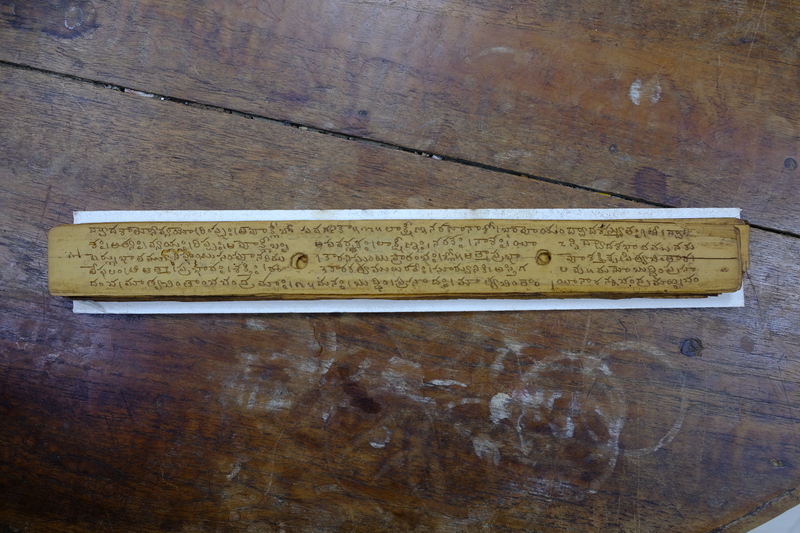
Unidentified Telugu Palm Leaf Manuscript
Physical ObjectJul 02, 2024